


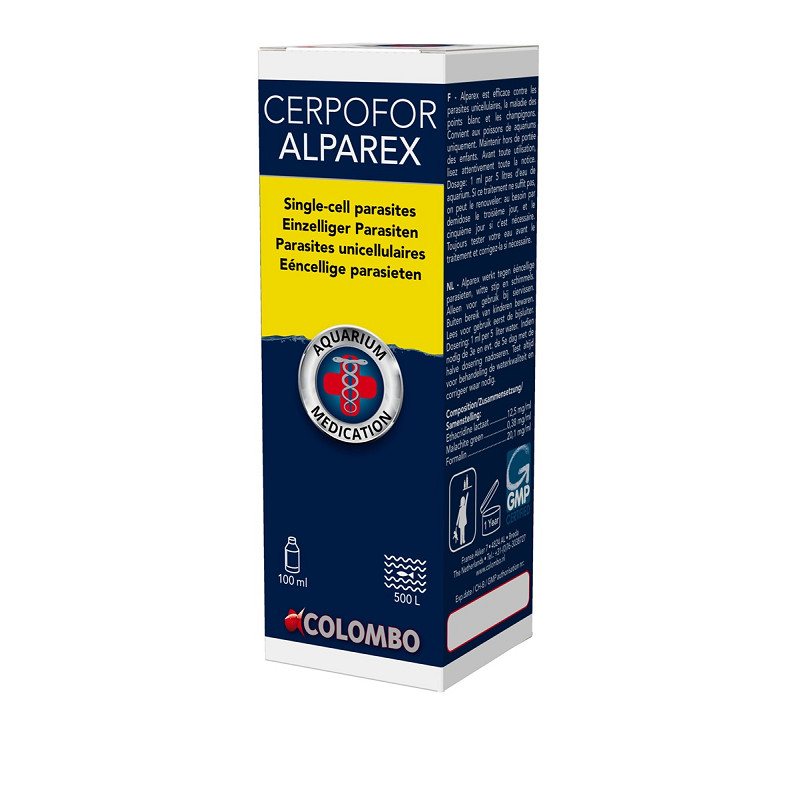
Cerpofor Alparex
User manual
Effective against invisible parasites, fungus and white spot disease.
Calculation of aquarium volume
Calculate the volume of the aquarium as accurately as possible: length x wide x height, measured in decimetres, gives the volume of the tank in litres. Deductions must then be made for the volume of any substrate, plants, stones, fossilised wood and ornaments etc. These normally represent some 10% but can account for up to 30% in well filled aquaria.
Cerpofor Alparex is available in the following sizes: 100 ml for 500 ltr of aquarium water and 1.000 ml for 5.000 ltr.
Water quality
For effective treatment and for the quick recovery of the diseased fish, good water quality is essential. Hence, always test the water quality before and after the treatment, and correct when necessary.
Dosage
1 ml per 5 litres aquarium water. Measure out the required amount in the measure provided, dissolve in 1 litre of aquarium water and spread out over the water surface. Turn on an aerator. A repeat treatment may be required in certain cases. This may be done using a half dosage on the 3rd and the 5th day, if necessary.
Remove carbon and zeolite during treatment; UV-lamps and ozone should be switched off until one week after the last administration. During the treatment no water changes should be made unless poor water quality demands it; in such a case re-dose at 1 ml per 5 ltr of added tap water.
The aquarium filter can stay on during the treatment. A treatment with Cerpofor Alparex discolours the water. To remove the colour from the water, you can restart your weekly water changes (we advise 10-20%) one week after the last addition of Alparex, and you can filter over active carbon.
Warning
As far as known, this product is harmless to invertebrates such as frogs, shrimps, freshwater lobsters and snails. Unfortunately we cannot guarantee this, so the use of Cerpofor Alparex in the presence of such animals is at your own risk. In case you have either positive or negative experiences, please notify us via www.colombo.nl or E-mail: info@colombo.nl
Cerpofor Alparex is developed for use in normal community aquaria with a pH between 7 and 8.5 and a KH of 4-8°DH. Specialised aquaria often have abnormal water values, leading to an abnormal, often negative response to Alparex; mainly tanks with a low pH and/or KH, as well as aquaria which make use of reverse osmosis water in which the conductivity is very low. Wild-caught fish can be very sensitive to medicines and often respond badly to medications as compared to captive bred fish. Use of Alparex in these situations is strictly at your own risk!
Only for use on ornamental fresh water fish in aquaria. Keep out of reach of children. Store in the box at a temperature of 4 to 32°C. Do not inhale. Prevent contact with the skin and eyes. If swallowed, immediately consult a physician and show package or label. This product causes permanent stains on clothing, paving materials, etc.
Combinations
Administration of more than 2 products and/or medications in one combination is at one’s own risk. Do not use at the same time together with products of other origin!
Information
White spot is caused by Ichthyophthirius multifiliis. This disease usually occurs when the natural resistance of fish is reduced or compromised. Examples of such circumstances include transportation, overcrowding or the addition of new fish. Affected fish show white spots on their skin, 0,1 to 1mm in size. These spots can be separate or clustered. The fish rub their skin on plants or rocks and may sometimes ‘rock’ back and forth in the water. After major loss of (breathing) skin surface or when the gills are affected, shortness of breath sets in and eventually the fish will die.
Fungal Infection (most caused by Saprolegnia) are marked by the appearance of greyish white, cotton-like growths on the skin and/or gills. The fungus grows on the skin surface, but can also penetrate to affect muscles and internal organs. These cases often prove to be fatal.
Itching can be caused by several parasites. Examples are: Trichodina, Ichthyobodo and Chilodonella, as well as Gyrodactylus (Skin flukes) and Dactylogyrus (gill flukes). These are flat sucker worms, app. 0,3-0,5 mm in size. The skin of fish serves as the main barrier against pathogens and infection by one parasite can open the way for others.
There are often several sorts of parasites present on the skin, and an infection can cause excessive production of slime resulting in a greyish white layer on the surface of the skin. This is easily detected on the eyes, or by looking at the fish from an angle. When the condition deteriorates, red spots appear, the gills swell and breathing becomes faster. Seriously affected fish tend to be listless: they lie on the bottom of the aquarium or chafe themselves on rocks or plants.
Cerpofor Alparex contains substances which act against the above named infections. Moreover, it is a disinfectant against secondary bacterial infections. In case of a serious bacterial infection, it is better to treat the fish with Cerpofor Bactyfec. When the itching continues after the treatment with Alparex, it’s recommended to treat the fish again after 14 days with Cerpofor Dactycid, a specific product against skin and gill flukes.