


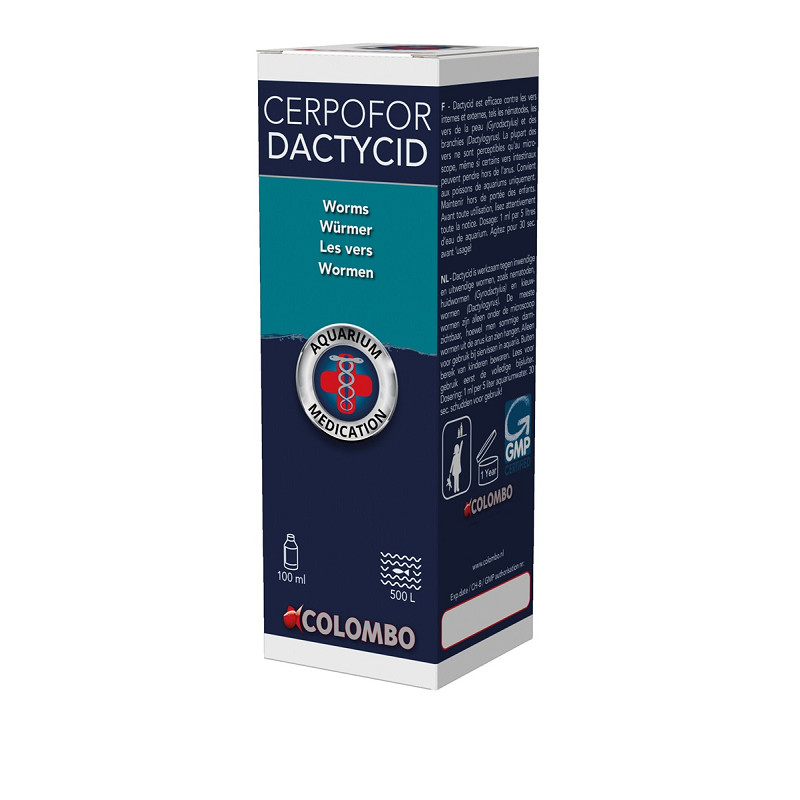
Cerpofor Dactycid
User manual
Effective against internal and external worms such as nematodes, skin worms (Gyrodactylus) and gill worms (Dactylogyrus).
Calculation of aquarium volume
Calculate the volume of the aquarium as accurately as possible: length x wide x height, measured in decimetres, gives the volume of the tank in litres. Deductions must then be made for the volume of any substrate, plants, stones, fossilised wood and ornaments etc. These normally represent some 10% but can account for up to 30% in well filled aquaria.
Cerpofor Dactycid is available in the following sizes: 100 ml for 500 ltr of aquarium water and 1.000 ml for 5.000 ltr.
Water quality
For effective treatment and for the quick recovery of the diseased fish, good water quality is essential. Hence, always test the water quality before and after the treatment, and correct when necessary.
Dosage
Shake for 30 sec before use! 1 ml per 5 litres aquarium water. Measure out the required amount in the measure provided and spread out over the water surface. Turn on an aerator. Change 25% of the water before application and after 48 hours another 25%. It is advisable to repeat the treatment after 14 days.
Remove carbon and zeolite during treatment; UV-lamps and ozone should be switched off until 48 hours after the last administration. During the treatment no water changes should be made unless poor water quality demands it; in such a case re-dose at 1 ml per 5 ltr of added tap water.
The aquarium filter can stay on during the treatment. One week after the last addition of Dactycid you can restart your weekly water changes (we advise 10-20%).
Warning
This product can be harmful for invertebrates such as frogs, shrimps, freshwater lobsters and snails as well as for Elephant fish and related species. The use of Cerpofor Dactycid is therefore not recommended in the presence of such animals. In case you have either positive or negative experiences, please notify us via www.colombo.nl or e-mail: info@colombo.nl
Cerpofor Dactycid is developed for use in normal community aquaria with a pH between 7 and 8.5 and a KH of 4-8°DH. Specialised aquaria often have abnormal water values, leading to an abnormal, often negative response to Dactycid; mainly tanks with a low pH and/or KH, as well as aquaria which make use of reverse osmosis water in which the conductivity is very low. Wild-caught fish can be very sensitive to medicines and often respond badly to medications as compared to captive bred fish. Use of Dactycid in these situations is strictly at your own risk!
Only for use on ornamental fresh water fish in aquaria. Keep out of reach of children. Store in the box at a temperature of 4 to 32°C. Do not inhale. Prevent contact with the skin and eyes. If swallowed, immediately consult a physician and show package or label.
Combinations
Administration of more than 2 products and/or medications in one combination is at one’s own risk. Do not use at the same time together with products of other origin!
Information
Hookworms (Acanthocephala) are provided with hooks which they use to attach themselves to the gut wall. The eggs are voided with the faeces. Roundworms (Nematodes) are large, round worms occurring in the digestive tract. Their larvae are also transmitted by, for example, weevils in the food. Some larvae migrate throughout the body of the fish an encapsulate in the muscles and organs. Under certain circumstances, these dormant larvae can mature to adult worms. Fish affected by these two types of worm become thin and have slimy faeces. Cammalanus cotti is a viviparous roundworm, which manifests itself as a string of reddish coloured worms, hanging out of the anus of the fish. The worms which are visible, are only the symptom of a multiple of worms which are present in the intestine. Skinworm and Gillworms are flat worms (monogenetic trematodes). Gyrodactylus is a skinworm which can also infest the gills while Dactylogyrus is a gillworm which can also occur on the skin. The larvae from these worms can swim on their own to infest other fish. Skinworms are highly viviparous, through which they are capable of rapid multiplication. This infestation results in a greyish, slimy appearance to the skin. Gill worms lay eggs and the hatched larvae can infest the gills in addition to the adult worms. The fish swim with the gills permanently open. Affected fish suffer from oxygen starvation and rub themselves against sand and stones. Secondary fungal infections quite often complicate the disease as does White Spot and bacterial infection. These problems can be combated using Cerpofor Alparex and Cerpofor Bactyfec. Hydras are freshwater polyps which can enter the aquarium via Daphnia. They multiply explosively on plants and panels and can prove problematical. They can also attach themselves to young fry fish. Planarians are small, whitish-grey flatworms and are usually found in large numbers on front facing panels, especially in the absence of lighting. The mostly feed on dead organic material but if this is in short supply they can parasitize the gills and skin as well as the mantel of snails.