


KH Test (carbonate hardness)
User manual
Understanding and adjusting the KH value
The KH is the so-called carbonate hardness or temporary hardness; in German Karbonathärte, abbreviated to KH. The KH is made up by forms of carbonic acid like bicarbonate and carbonate. The chemical balance between these substances leads to a stable pH and thus the adequate presence of these substances is essential for a stable pH; a stable pH in its turn is essential for the well-being of the fish. The KH is therefore often called the buffering capacity of the water.
Especially in older aquaria and ponds, the pH and KH have a tendency to decrease, especially when there are no or little water changes. Hence, test the KH regularly and refresh 10% of the water weekly.
An optimal pH-buffer in freshwater is obtained with a KH between 6 and 10°DH, in seawater with a KH between 8 and 12°DH. When the KH is above 12°DH, also the pH will be relatively high, and so you can lower both values in freshwater with Colombo pH-min. Is the KH lower than 6 or 8°DH, you can increase it with Colombo KH+.
General Guidelines
- Always take care that the test tube is clean before use.
- Clean the tube directly after use.
- Take the volume of the water sample as precisely as possible.
- Keep the drop bottle perfectly vertical during dropping.
- Take care that no air bubbles are included in the drops.
Test procedure:
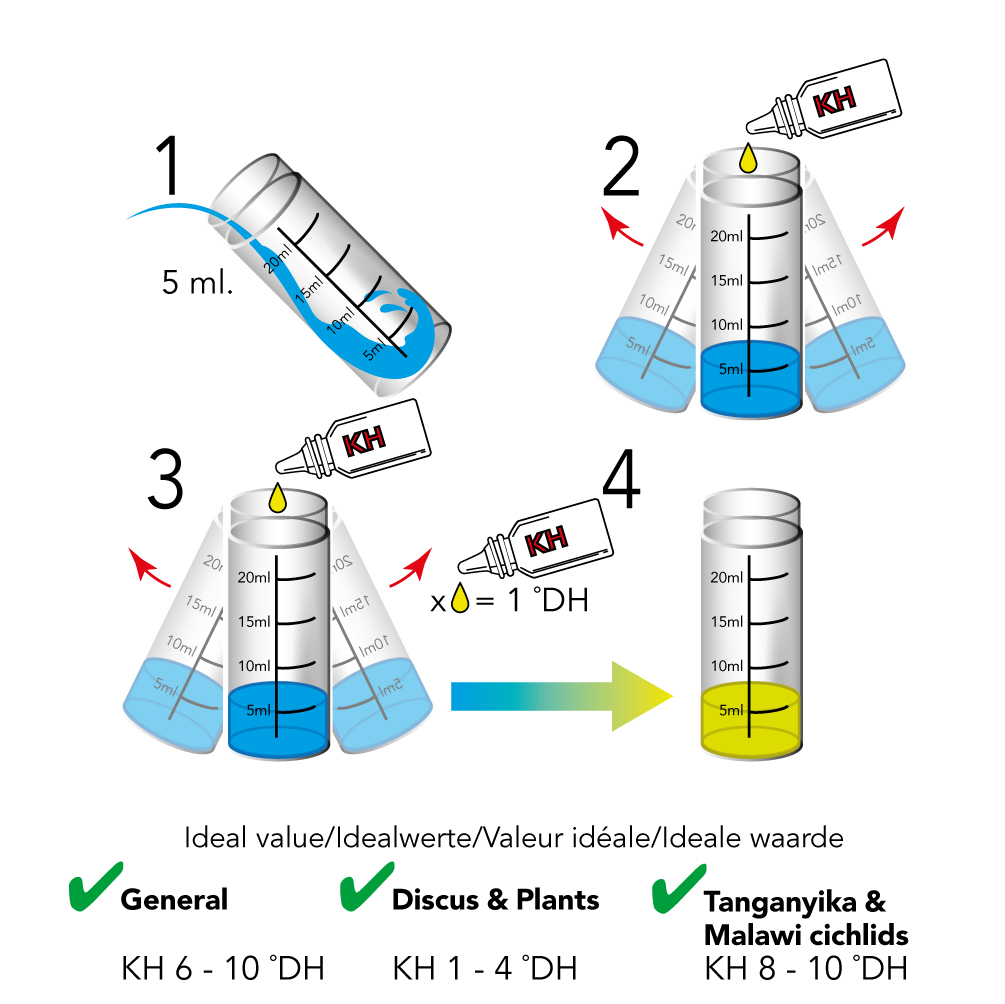
- Take a water sample of 5 ml.
- Add 1 drop of KH-test fluid and mix. The sample should turn light-blue; when it turns yellow, the KH of the water is lower than 1°DH
- Add KH-test fluid drop by drop and mix each time, until the sample turns yellow.
- The total number of drops added to induce the colour change from blue to yellow, is equal to KH-value in °DH, so 2 drops =2°DH, 3 drops =3°DH and so on.
Test procedure:
- Take a water sample of 5 ml.
- Add 1 drop of KH-test fluid and mix. The sample should turn light-blue; when it turns yellow, the KH of the water is lower than 1°DH
- Add KH-test fluid drop by drop and mix each time, until the sample turns yellow.
- The total number of drops added to induce the colour change from blue to yellow, is equal to KH-value in °DH, so 2 drops =2°DH, 3 drops =3°DH and so on.
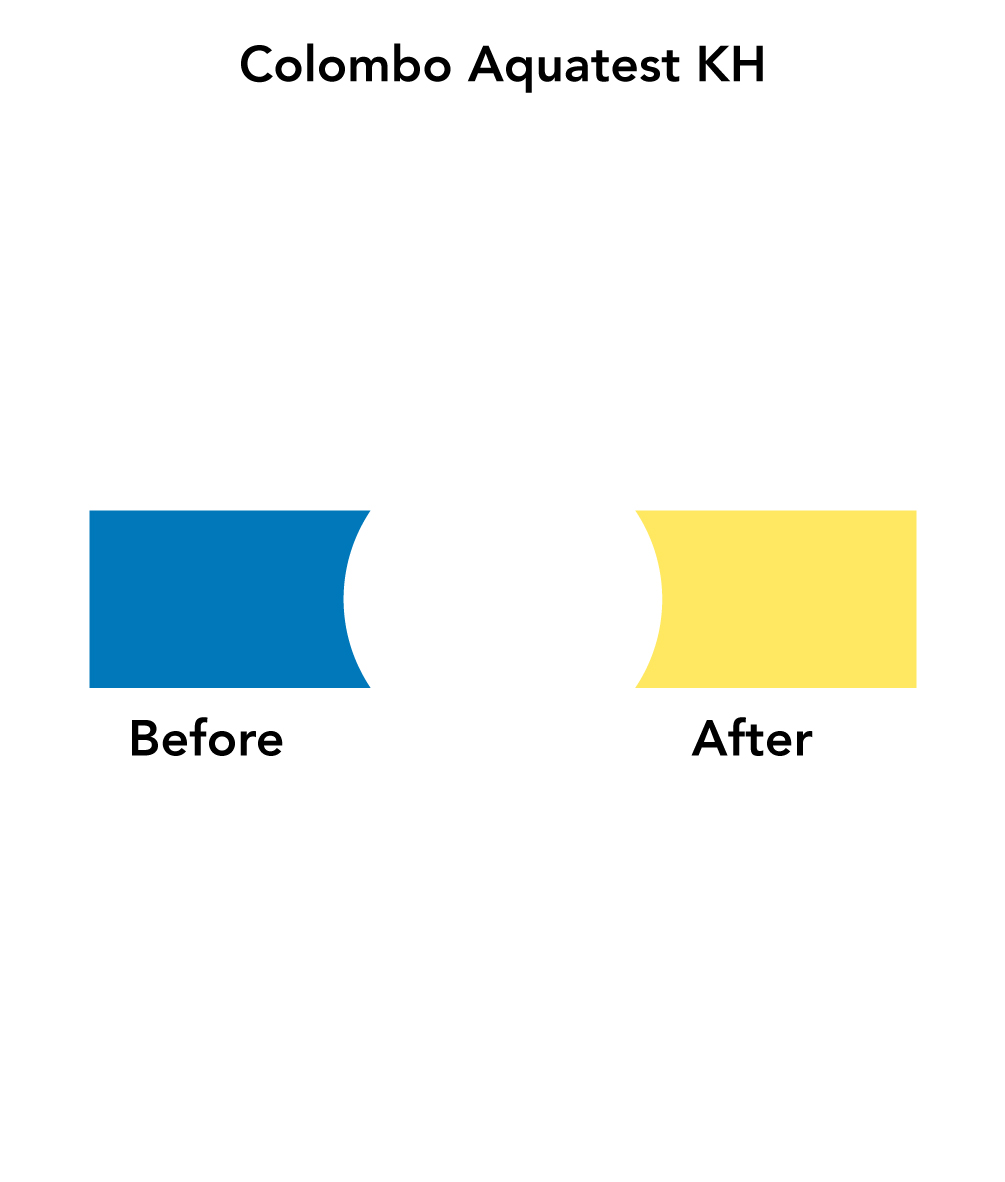
In the test where drops are to be counted, like KH and GH, the moment at which the colour changes is the point at which the true value is reached. The number of drops added to reach that point can be converted to the true value. The colour change is reached within one or two drops. Within the one or two drops the sample has an intermediate colour. The true end value is only reached when the colour doesn’t change anymore. These Colombo-tests are calibrated with professional laboratory tests, ensuring the most precise test possible.
In the test where drops are to be counted, like KH and GH, the moment at which the colour changes is the point at which the true value is reached. The number of drops added to reach that point can be converted to the true value. The colour change is reached within one or two drops. Within the one or two drops the sample has an intermediate colour. The true end value is only reached when the colour doesn’t change anymore. These Colombo-tests are calibrated with professional laboratory tests, ensuring the most precise test possible.