
Marine KH Test
User manual
Understanding and adjusting the KH value
The KH is the so-called carbonate hardness or temporary hardness; in German Karbonathärte, abbreviated to KH. The KH is made up by forms of carbonic acid like bicarbonate and carbonate. The chemical balance between these substances leads to a stable pH and thus the adequate presence of these substances is essential for a stable pH; a stable pH in its turn is essential for the well-being of the fish. The KH is therefore often called the buffering capacity of the water.
Especially in older aquaria, the pH and KH have a tendency to decrease, especially when there are no or little water changes. Hence, test the KH regularly and refresh 10% of the water weekly.
An optimal pH-buffer in seawater is obtained with a KH between 8 and 12°DH. When the KH is lower than 8°DH, you can increase it with Colombo Marine KH Plus.
General Guidelines
- Always take care that the test tube is clean before use.
- Clean the tube directly after use.
- Take the volume of the water sample as precisely as possible.
- Keep the drop bottle perfectly vertical during dropping.
- Take care that no air bubbles are included in the drops.
Test procedure:
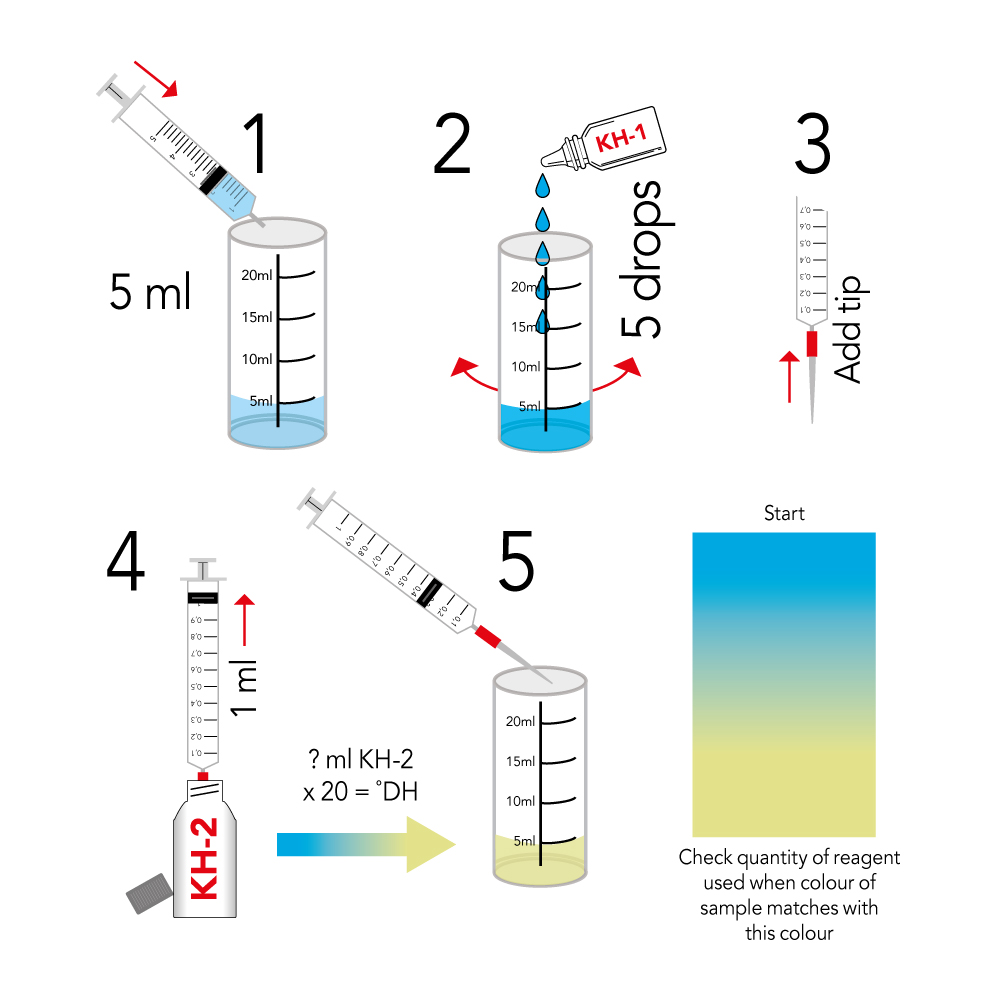
- Take a water sample of 5 ml.
- Add 5 drops of KH-1 test fluid and mix. The sample should turn lightblue; when it turns yellow, the KH of the water is lower than 1°DH.
- Mount the plastic tip onto the 1 ml syringe and fill the syringe with KH-2 test fluid. Above the fluid an air bubble will appear, this is normal. The air compensates for the volume in the tip.
- Add the fluid slowly until the sample colours yellow.
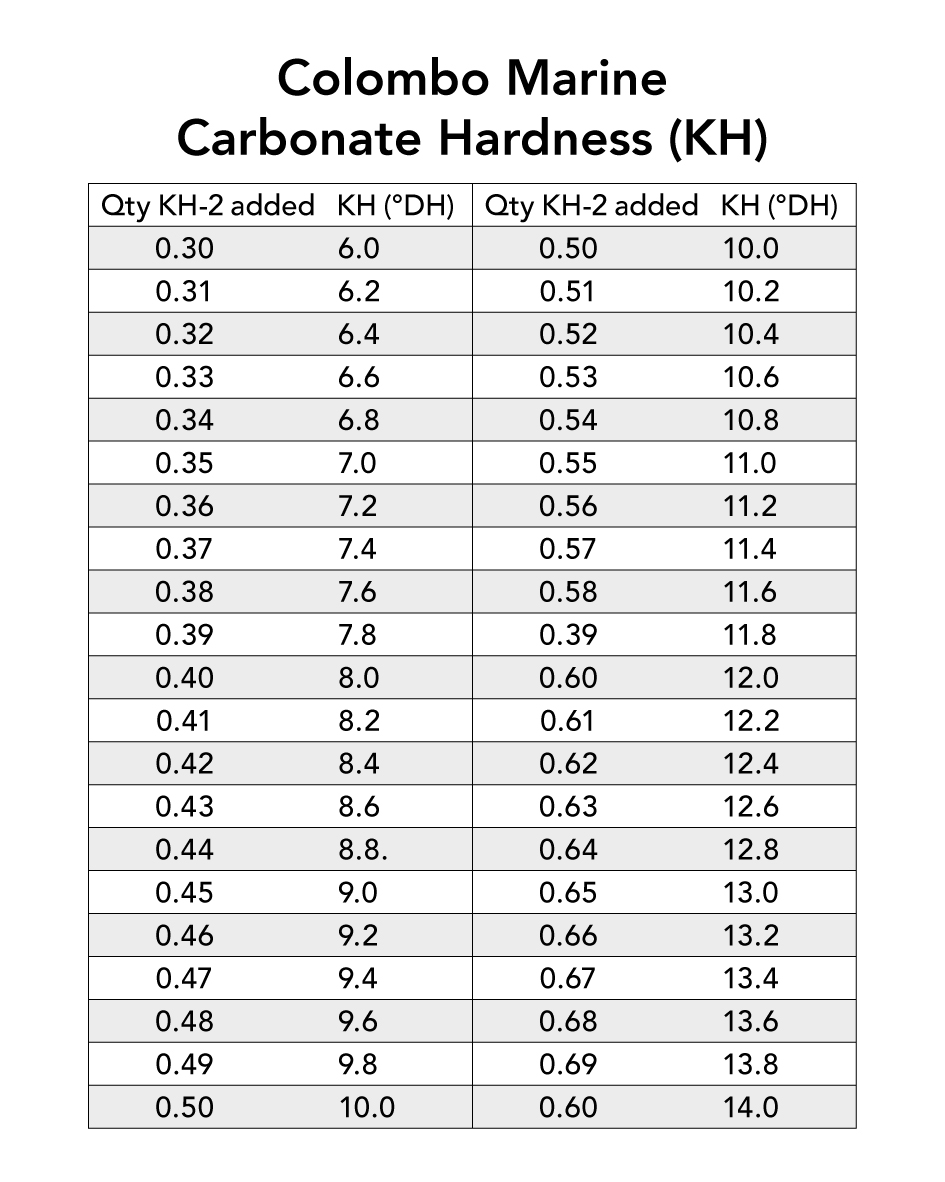
- Multiply the volume of KH-2 test fluid (in ml) required to change the colour from blue to yellow by 20 to determine the KH value in °dH.
Alternatively, use the chart in this manual.
Test procedure:
- Take a water sample of 5 ml.
- Add 5 drops of KH-1 test fluid and mix. The sample should turn lightblue; when it turns yellow, the KH of the water is lower than 1°DH.
- Mount the plastic tip onto the 1 ml syringe and fill the syringe with KH-2 test fluid. Above the fluid an air bubble will appear, this is normal. The air compensates for the volume in the tip.
- Add the fluid slowly until the sample colours yellow.
- Multiply the volume of KH-2 test fluid (in ml) required to change the colour from blue to yellow by 20 to determine the KH value in °dH.
Alternatively, use the chart in this manual.