


Marine Nitrate Test (NO3)
User manual
Understanding and controlling nitrate levels
Nitrate is the main nutrient in seawater for the growth of nuisance algae. Keeping nitrate levels low is therefor vital in combatting unwanted algae. Hence, measuring nitrate levels in a precise way is very important.
You can keep nitrate levels low with Colombo Nitrate-Ex. We advise to keep nitrate levels as low as 1 mg/l.
When a tank is algae-free and a high coral growth is achieved, nitrate levels of 2-4 mg/l can be required to support optimal coral growth, as the high coral growth will suppress the algal growth.
General Guidelines
- Always take care that the test tube is clean before use.
- Clean the tube directly after use.
- Take the volume of the water sample as precisely as possible.
- Keep the drop bottle perfectly vertical during dropping.
- Take care that no air bubbles are included in the drops.
Test procedure:
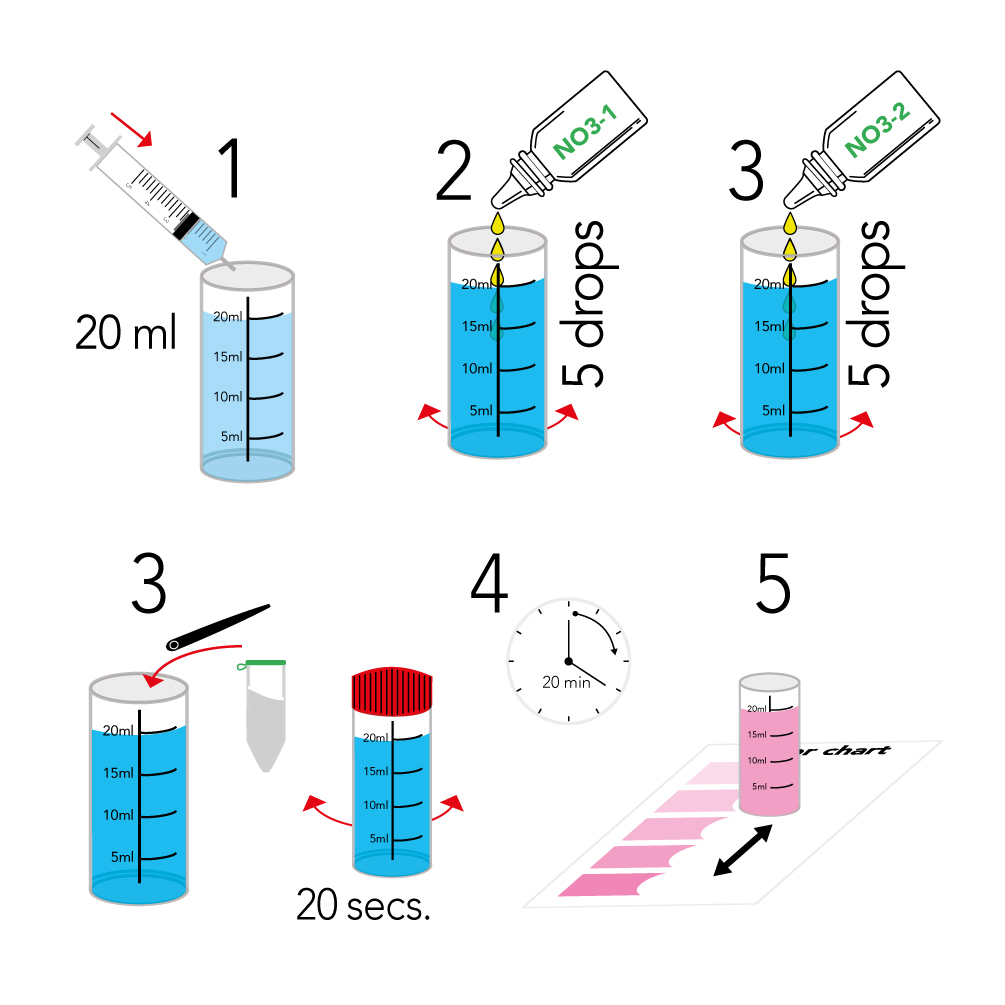
- Take a water sample of 20 ml.
- Add 5 drops of NO3-1 test fluid and shake.
- Add 5 drops of NO3-2 test fluid and shake again.
- Add 1 spoon of nitrate powder (tube with green cap).
- Shake for 20 seconds.
- Wait 20 minutes and determine the NO3-value using the included colour chart.
The measuring range of our Marine Nitrate Test is 0 – 4 mg/l. However the test range can be adjusted to 0 – 8 mg/l or 0 – 16 mg/l.
See chapter: How to adjust the range of the test.
Test procedure:
- Take a water sample of 20 ml.
- Add 5 drops of NO3-1 test fluid and shake.
- Add 5 drops of NO3-2 test fluid and shake again.
- Add 1 spoon of nitrate powder (tube with green cap).
- Shake for 20 seconds.
- Wait 20 minutes and determine the NO3-value using the included colour chart.
The measuring range of our Marine Nitrate Test is 0 – 4 mg/l. However the test range can be adjusted to 0 – 8 mg/l or 0 – 16 mg/l.
See chapter: How to adjust the range of the test.
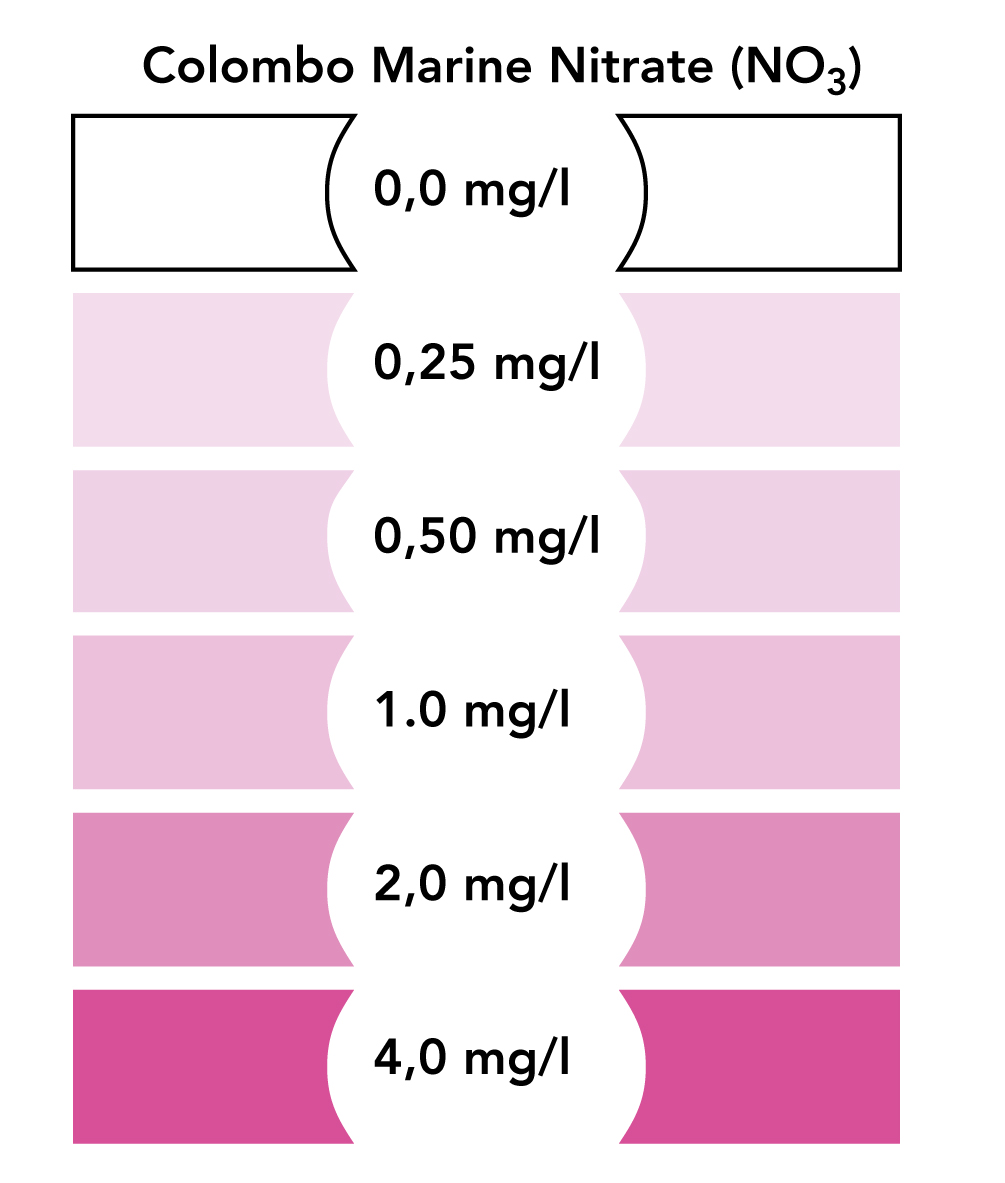
For judging the colour of the water sample after adding all the test fluids, proceed as follows: put the test tube on the included colour chart and look through the tube on to the chart from directly above it. Do not look in direct sun light, but at indirect light. Compare the colour of the water sample with the colours on the chart. The closest colour shows the corresponding value. Generally the colours of the sample and on the chart will not be exactly the same, as values in practice will always be between the standard values, and thus a mixture of both consecutive values. Therefore, one should estimate between which colours the sample really lies.
For judging the colour of the water sample after adding all the test fluids, proceed as follows: put the test tube on the included colour chart and look through the tube on to the chart from directly above it. Do not look in direct sun light, but at indirect light. Compare the colour of the water sample with the colours on the chart. The closest colour shows the corresponding value. Generally the colours of the sample and on the chart will not be exactly the same, as values in practice will always be between the standard values, and thus a mixture of both consecutive values. Therefore, one should estimate between which colours the sample really lies.
How to adjust the range of the test
The measuring range of our Nitrate test is 0 – 4 mg/l. For reef tanks a Nitrate value of >4 mg/l is not recommended and can even be harmful for corals. When water with a Nitrate content of > 4 mg/l is tested our test will show a deep red colour, indicating the Nitrate level is 4 mg/l or higher.
If you want to determine the Nitrate content in this case you can adjust the range of the test up to 8 mg/l or 16 mg/l. In order to do this the water sample must be diluted with reverse osmosis water (RO water).

Test the reverse osmosis water (RO water) you want to use to dilute the sample before use!
Make sure the RO water does not contain any Nitrates.
Increasing the test range to 8 mg/l.
Take a water sample of 10 ml from your tank and add 10 ml RO water. Follow the standard instructions to test the Nitrate content. Compare the colour of the sample with the colour chart and double the value. E.g. 0.25 mg/l becomes 0.5 mg/l; 0.5 mg/l becomes 1.0 mg/l and so on.
Increasing the test range to 16 mg/l.
Take a water sample of 5 ml from your tank and add 15 ml RO water. Follow the standard instructions to test the Nitrate content. Compare the colour of the sample with the colour chart and quadruple the value. E.g. 0.25 mg/l becomes 1.0 mg/l; 0.5 mg/l becomes 2.0 mg/l and so on.