
Marine Potassium Test (K)
User manual
Understanding and controlling Potassium levels
Potassium and Boron are important elements for the growth and color development (especially red) of corals. As it is difficult to measure the individual level of each of these elements in seawater, we take potassium as a representative.
By adding Colombo Marine Colors 2 Potassium, you add both potassium and boron in the correct ratio. The amount of product to add, is based on the potassium concentration.
We advise to maintain a potassium level of around 400 mg/l.
General Guidelines
- Always take care that the test tube is clean before use.
- Clean the tube directly after use.
- Take the volume of the water sample as precisely as possible.
- Keep the drop bottle perfectly vertical during dropping.
- Take care that no air bubbles are included in the drops.
Test procedure:
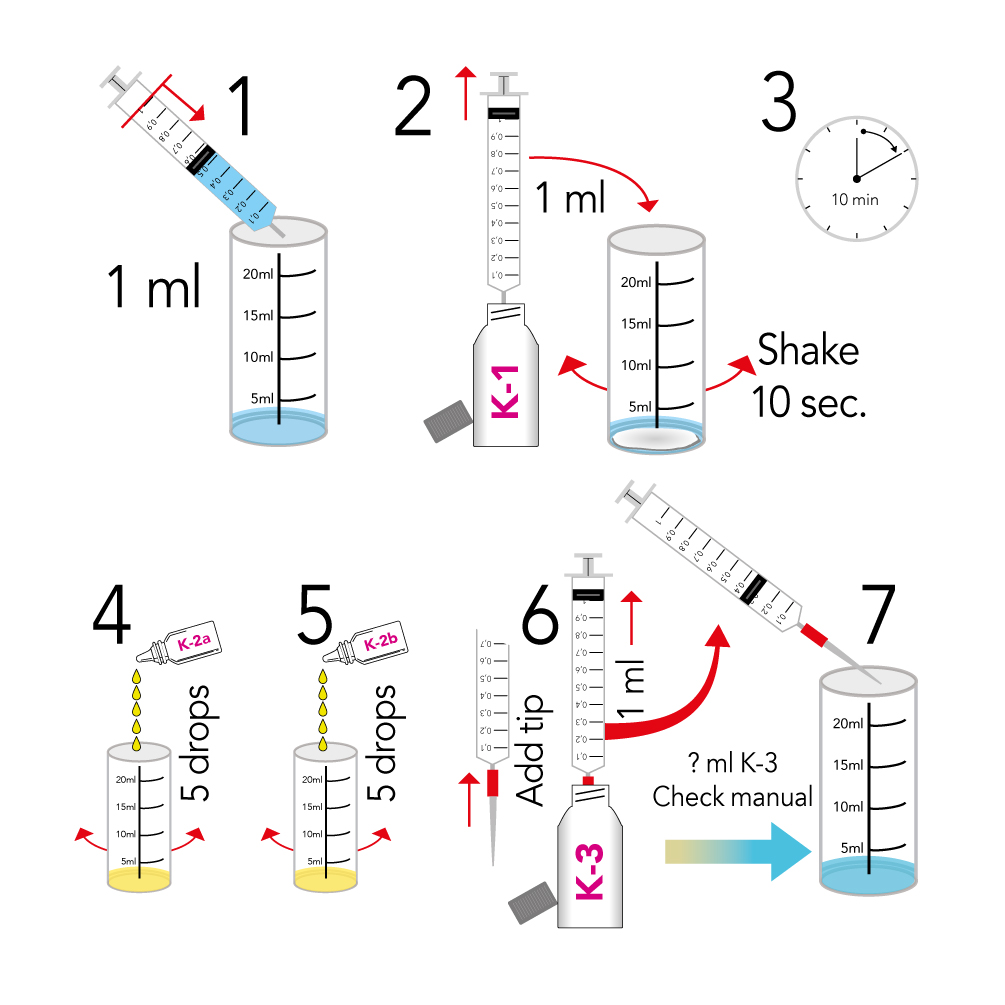
- Take a water sample of 1 ml with one of three syringes. Mark the syringes and use them for one test fluid only.
- Add with another syringe 1.0 ml K-1 test fluid and shake the tube for 10 seconds. A white precipitation will occur making the sample turbid.
- Wait for 10 minutes.
- Add 5 drops of K-2a test fluid and shake. Subsequently add 5 drops of K-2b test fluid and shake, the sample colours yellow.
- Mount the plastic tip onto the last 1 ml syringe and fill the syringe with exactly 1,0 ml of K-3 test fluid. Above the fluid an airbubble will appear, this is normal. The air compensates for the volume in the tip. Add the fluid slowly until the sample colours blue.
- Multiply the volume of K-3 test fluid (in ml) required to change the colour from yellow to blue by 250, then subtract the result from 500 to determine the potassium content. (E.g. 0,48 ml needed to convert from yellow to bleu = 0,48 x 250 = 120, subsequently 500 – 120 = 380 mg Potassium per litre).
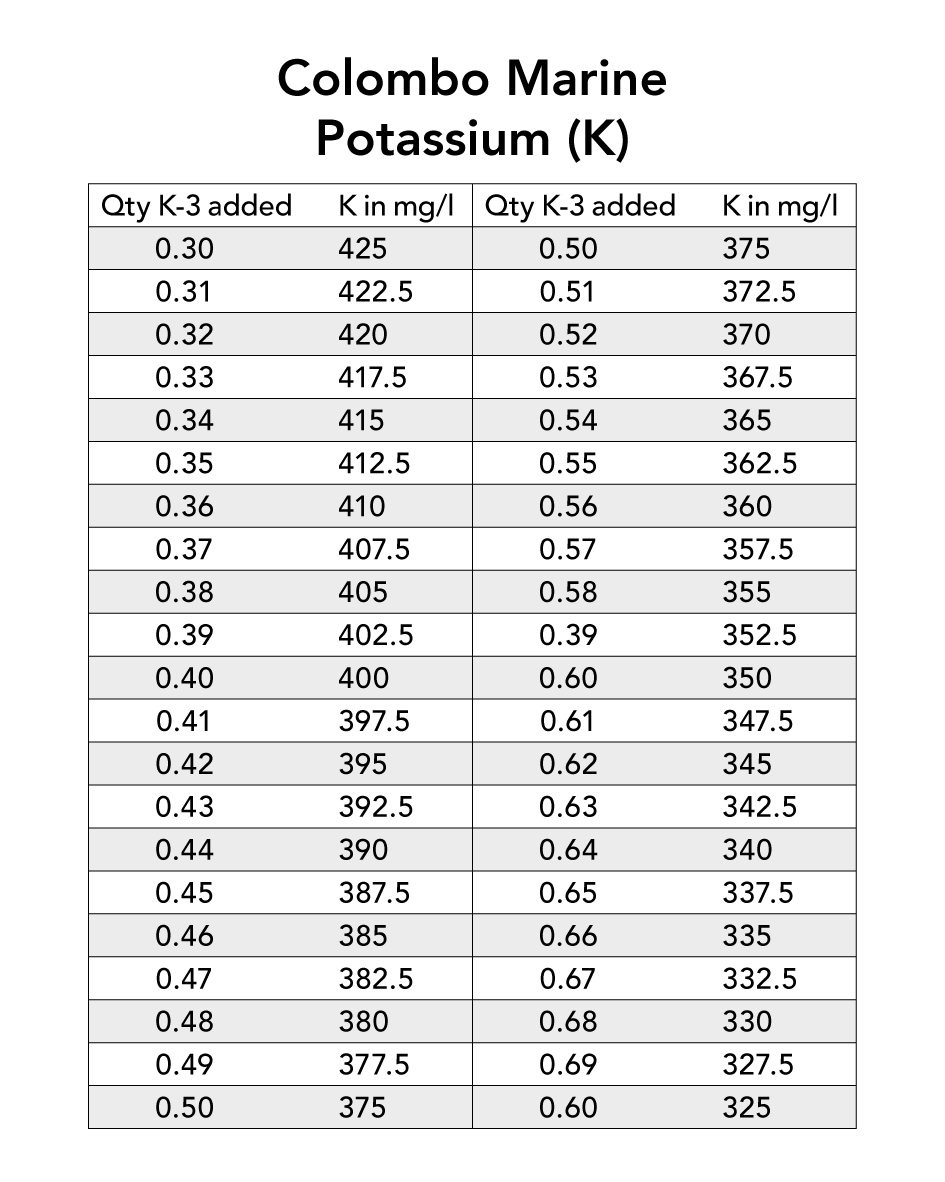
Alternatively, use the chart in this manual.
Test procedure:
- Take a water sample of 1 ml with one of three syringes. Mark the syringes and use them for one test fluid only.
- Add with another syringe 1.0 ml K-1 test fluid and shake the tube for 10 seconds. A white precipitation will occur making the sample turbid.
- Wait for 10 minutes.
- Add 5 drops of K-2a test fluid and shake. Subsequently add 5 drops of K-2b test fluid and shake, the sample colours yellow.
- Mount the plastic tip onto the last 1 ml syringe and fill the syringe with exactly 1,0 ml of K-3 test fluid. Above the fluid an airbubble will appear, this is normal. The air compensates for the volume in the tip. Add the fluid slowly until the sample colours blue.
- Multiply the volume of K-3 test fluid (in ml) required to change the colour from yellow to blue by 250, then subtract the result from 500 to determine the potassium content. (E.g. 0,48 ml needed to convert from yellow to bleu = 0,48 x 250 = 120, subsequently 500 – 120 = 380 mg Potassium per litre).
Alternatively, use the chart in this manual.