


Nitrate Test (N03)
User manual
Understanding and controlling nitrate levels
Nitrate (NO3) is the end product of the degradation of ammonia by nitrifying bacteria in your aquarium or pond. Nitrate is not toxic for fish and thus is no direct problem for the health of fish like ammonia or nitrite are; high concentrations however can on the long run reduce growth and reproduction of fish.
Indirectly, nitrate can lead to algae problems as nitrate is one of the key nutrients for algae and plants. Plants and algae compete with one another for nutrients and unfortunately plants can’t always win this competition. In such a case, algae can grow and even explode in numbers.
In a pond this results in either turbid, green water or in mass amounts of thread algae.
In aquaria algae can completely cover the glass, stones and even plants, leading to their death.
Although nitrate is basically not toxic, it is highly desirable to keep the level low to prevent algae growth. For fresh water we advise a threshold of 50 mg/l. This can best be accomplished by making regular water changes.
General Guidelines
- Always take care that the test tube is clean before use.
- Clean the tube directly after use.
- Take the volume of the water sample as precisely as possible.
- Keep the drop bottle perfectly vertical during dropping.
- Take care that no air bubbles are included in the drops.
Test procedure:
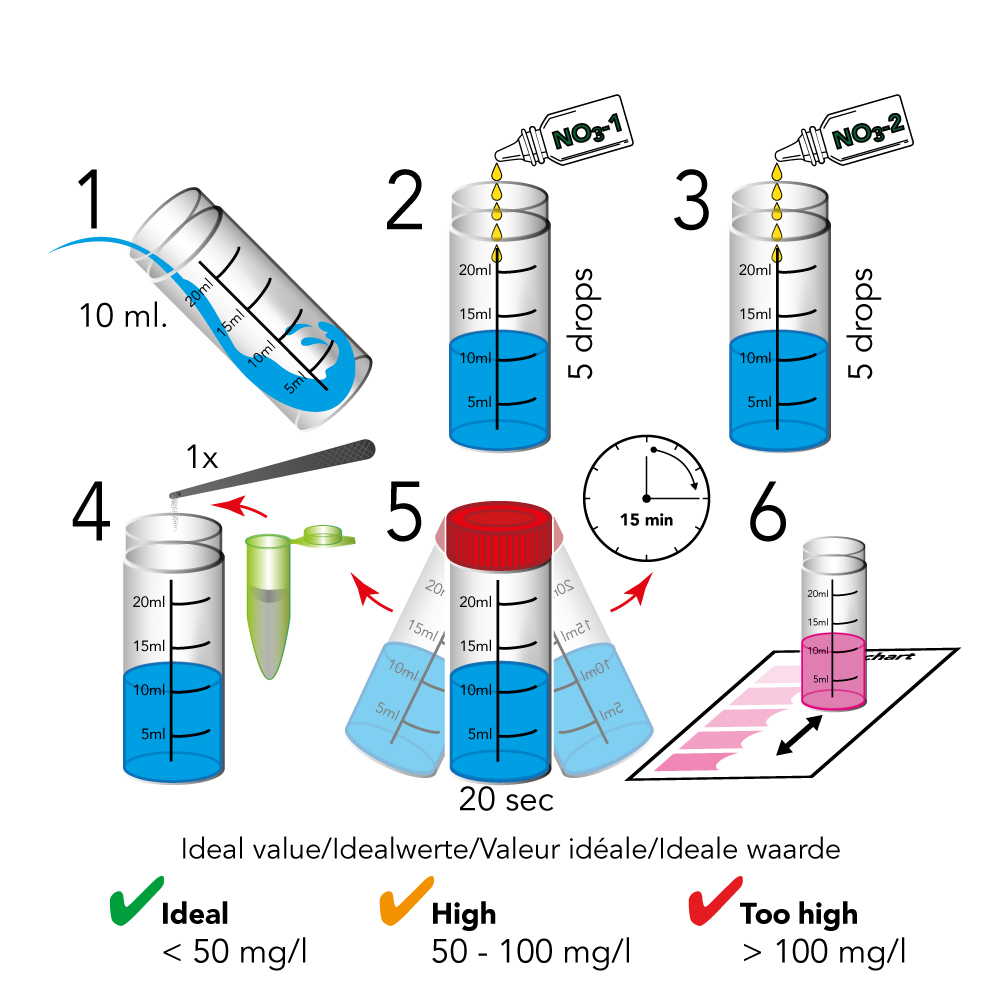
- Take a water sample of 10 ml.
- Add 5 drops of NO3-1 test fluid and shake.
- Add 5 drops of NO3-2 test fluid and shake again.
- Add 1 spoon of nitrate powder (tube with green cap).
- Shake for 20 seconds.
- Wait 15 min. and determine the NO3-value using the colour chart.
Test procedure:
- Take a water sample of 10 ml.
- Add 5 drops of NO3-1 test fluid and shake.
- Add 5 drops of NO3-2 test fluid and shake again.
- Add 1 spoon of nitrate powder (tube with green cap).
- Shake for 20 seconds.
- Wait 15 min. and determine the NO3-value using the colour chart.
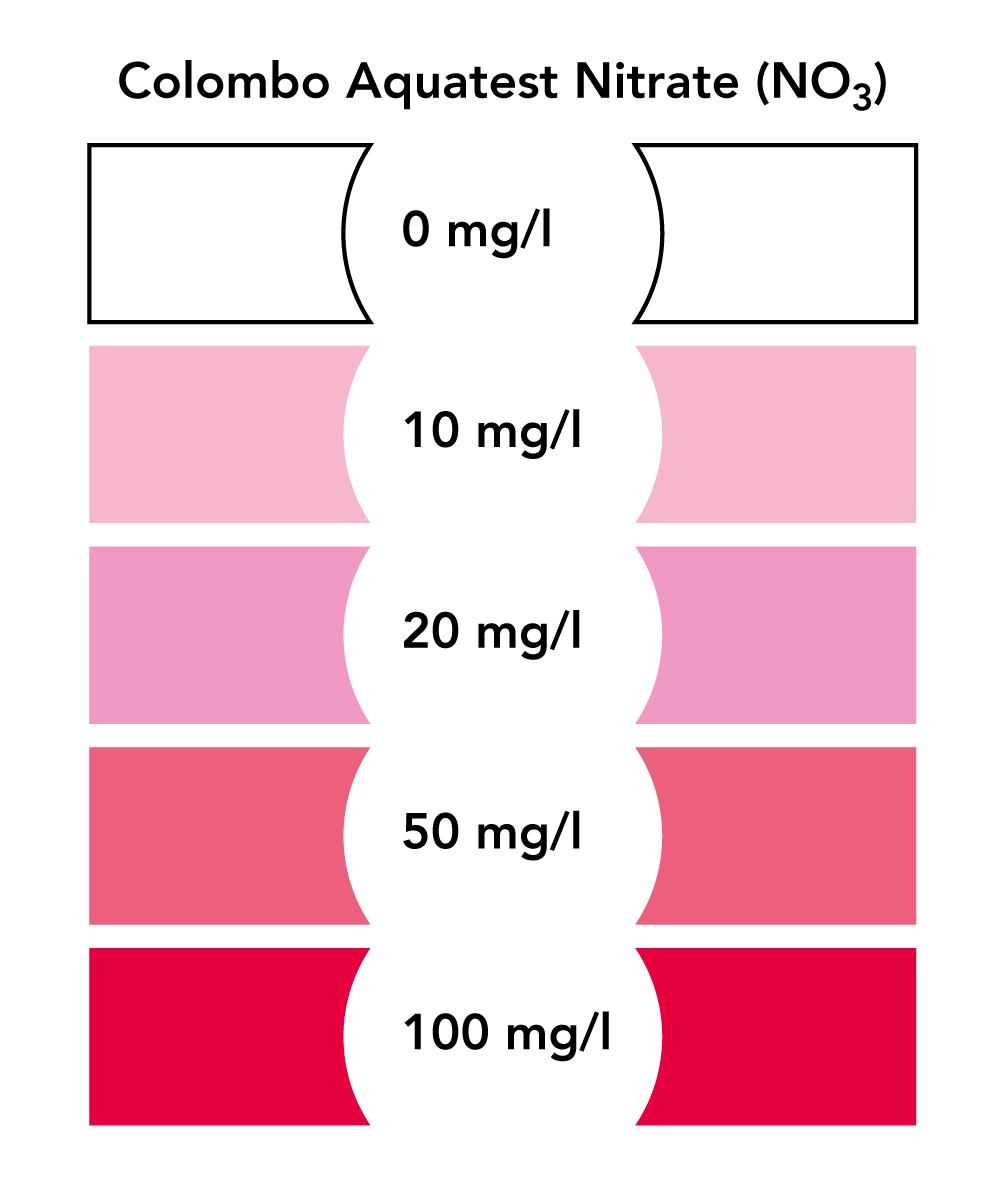
For judging the colour of the water sample after adding all the test fluids, proceed as follows: put the test tube on the included colour chart and look through the tube on to the chart from directly above it. Do not look in direct sun light, but at indirect light. Compare the colour of the water sample with the colours on the chart. The closest colour shows the corresponding value. Generally the colours of the sample and on the chart will not be exactly the same, as values in practice will always be between the standard values, and thus a mixture of both consecutive values. Therefore, one should estimate between which colours the sample really lies.
For judging the colour of the water sample after adding all the test fluids, proceed as follows: put the test tube on the included colour chart and look through the tube on to the chart from directly above it. Do not look in direct sun light, but at indirect light. Compare the colour of the water sample with the colours on the chart. The closest colour shows the corresponding value. Generally the colours of the sample and on the chart will not be exactly the same, as values in practice will always be between the standard values, and thus a mixture of both consecutive values. Therefore, one should estimate between which colours the sample really lies.