


pH Test (acidity)
User manual
Understanding and adjusting the pH value
The pH-value is a measure for the acidity of the water. This can vary from 0 to 14, with 7 being neutral, lower being acidic and higher being basic. The most important thing about the pH is that it is within the tolerant range of the fish that are kept, and that the pH is stable; for this stability the carbonate hardness (KH) is important, see KH for more information.
Especially in older aquaria and ponds the pH has a tendency to decrease, especially when there are little or no water changes. Hence, test the pH regularly and refresh 10% of the water weekly.
The ideal pH for a normal freshwater aquarium is between 6.5 and 7.5. When the pH is too high, you can lower it with Colombo pH-. When the pH is too low, you can raise it with Colombo KH+.
In specialised aquaria the pH range is different e.g. discus fish (pH between 6.0 and 7.0) or Tanganyika cichlids (pH between 8.0 and 9.0). The ideal pH of a pond is between 7.0 and 8.5.
A higher pH is rarely encountered in ponds; however should this be the case, you can lower the pH by using Colombo pH-min. In case of a low pH, add Colombo KH+ in order to increase it.
General Guidelines
- Always take care that the test tube is clean before use.
- Clean the tube directly after use.
- Take the volume of the water sample as precisely as possible.
- Keep the drop bottle perfectly vertical during dropping.
- Take care that no air bubbles are included in the drops.
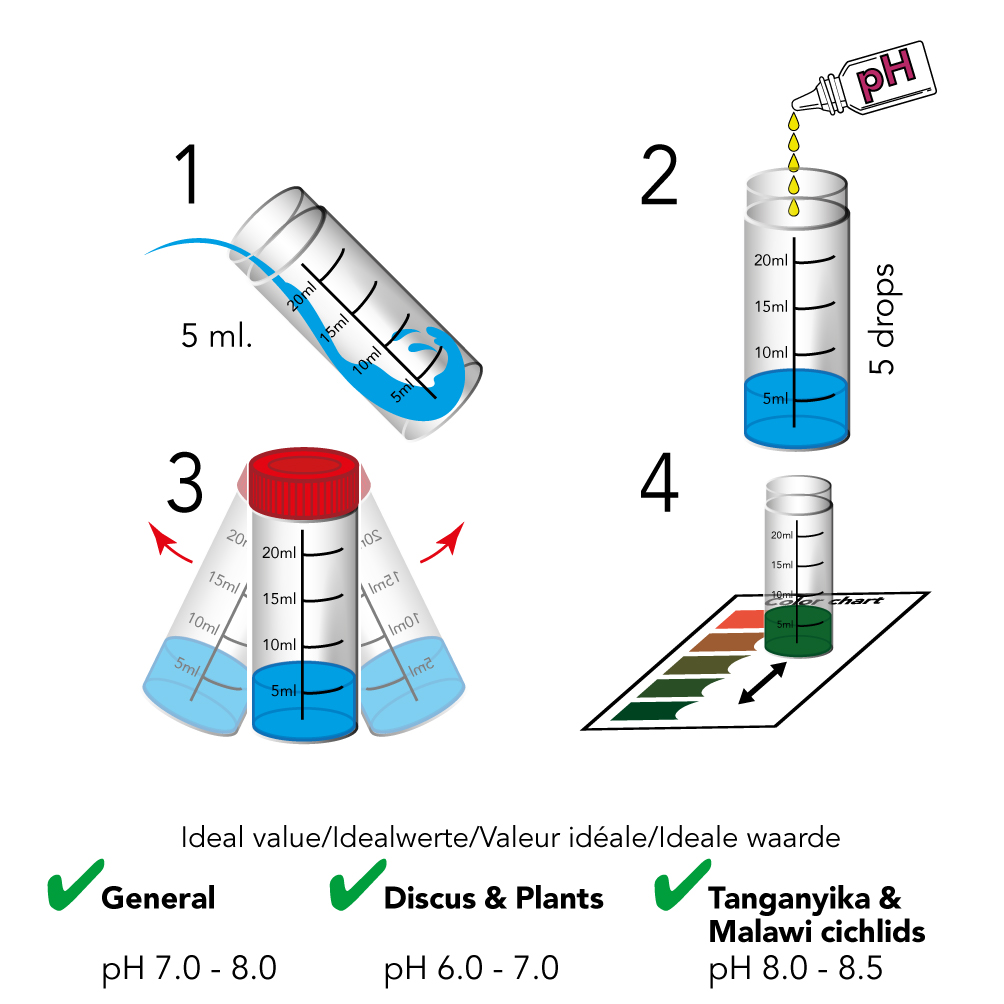
Test procedure:
- Take a water sample of 5 ml.
- Add 5 drops of pH-test fluid
- Shake test tube.
- Determine the pH-value using the included colour chart.
Test procedure:
- Take a water sample of 5 ml.
- Add 5 drops of pH-test fluid
- Shake test tube.
- Determine the pH-value using the included colour chart.
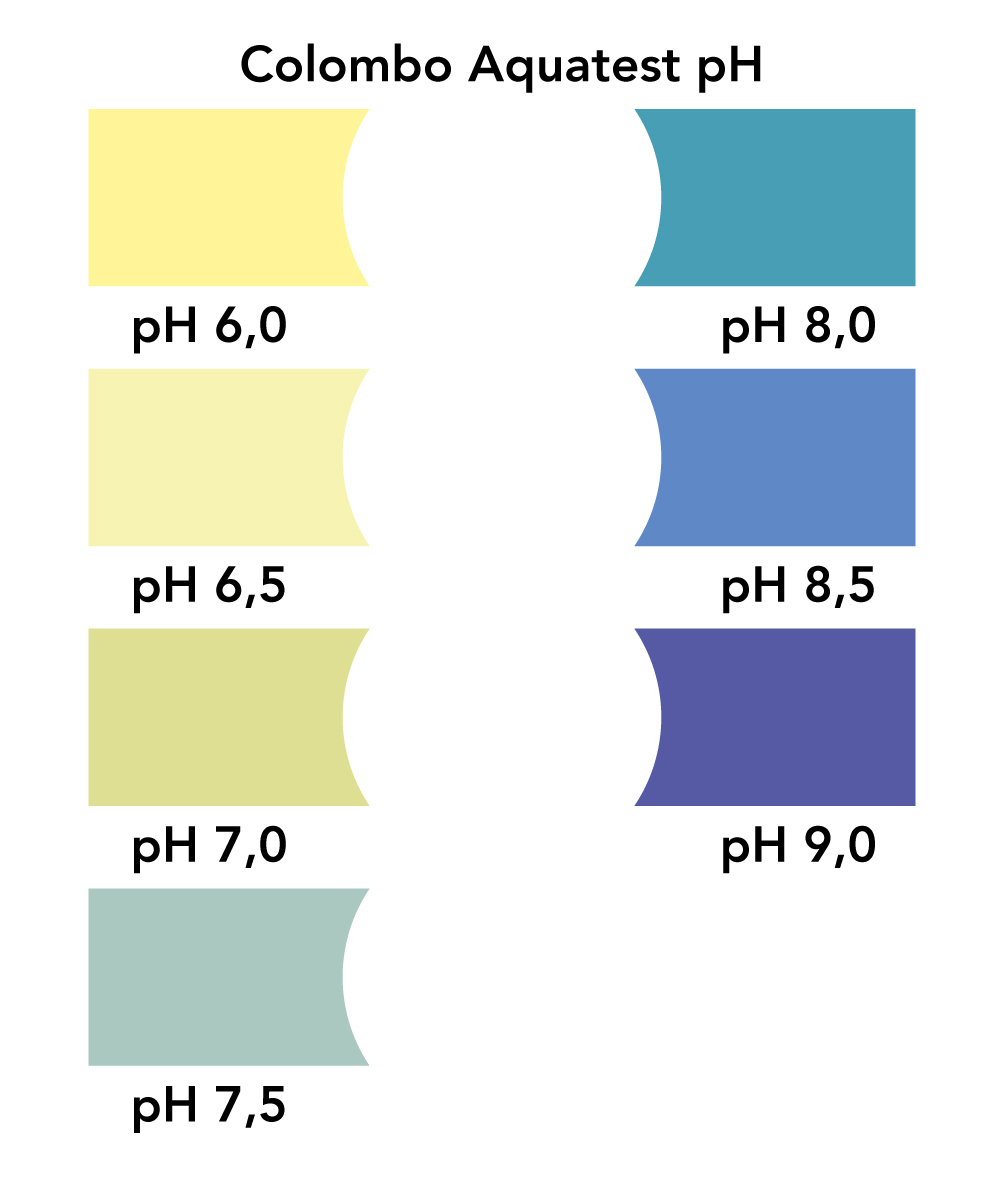
For judging the colour of the water sample after adding all the test fluids, proceed as follows: put the test tube on the included colour chart and look through the tube on to the chart from directly above it. Do not look in direct sun light, but at indirect light. Compare the colour of the water sample with the colours on the chart. The closest colour shows the corresponding value. Generally the colours of the sample and on the chart will not be exactly the same, as values in practice will always be between the standard values, and thus a mixture of both consecutive values. Therefore, one should estimate between which colours the sample really lies.
For judging the colour of the water sample after adding all the test fluids, proceed as follows: put the test tube on the included colour chart and look through the tube on to the chart from directly above it. Do not look in direct sun light, but at indirect light. Compare the colour of the water sample with the colours on the chart. The closest colour shows the corresponding value. Generally the colours of the sample and on the chart will not be exactly the same, as values in practice will always be between the standard values, and thus a mixture of both consecutive values. Therefore, one should estimate between which colours the sample really lies.