


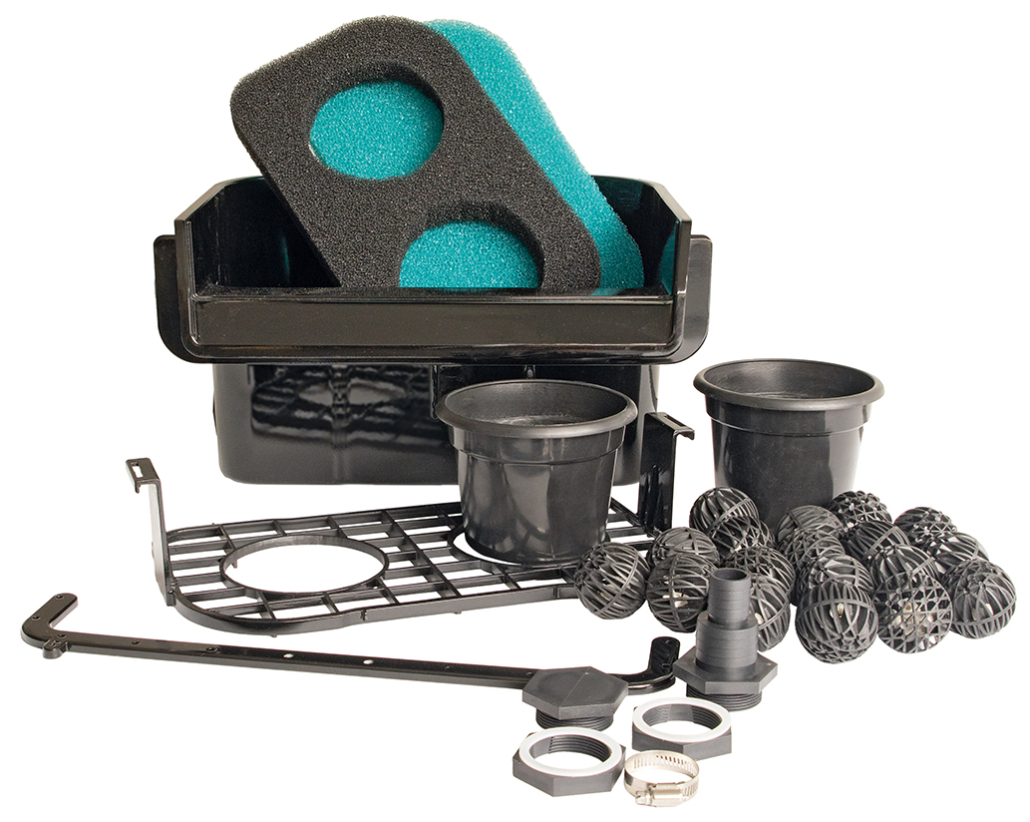
Waterfall Plant Filter
User manual
Function
2-in-1 Waterfall and mini-plant filter
Connect the Waterfall Plant Filter to a pond pump or pressure filter and the water flows back into the pond. This is not only a beautiful sight, it brings life to the pond and creates a calming effect. The Waterfall Plant Filter is equipped with two pots so that it can also be used as a simple plant filter. To do this, place helophyte plants such as dwarf licorice, yellow iris, featherweed or reed in the pots.
Overview
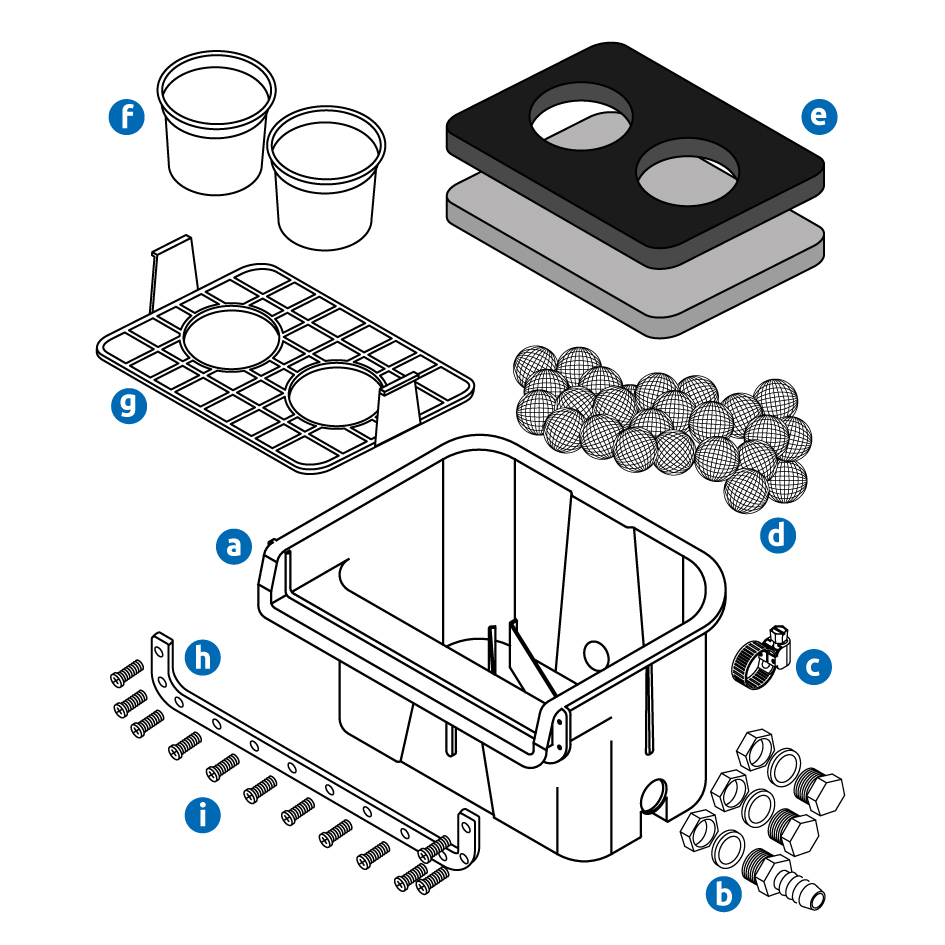
a – Filter container
b – Hose tail + sealing caps
c – Hose clamp
d – Bio-Balls
e – Filter foam
f – Plant pots
g – Remouvable rack
h – Liner Bracket
i – Screws
Installation
Choose the desired location around the pond
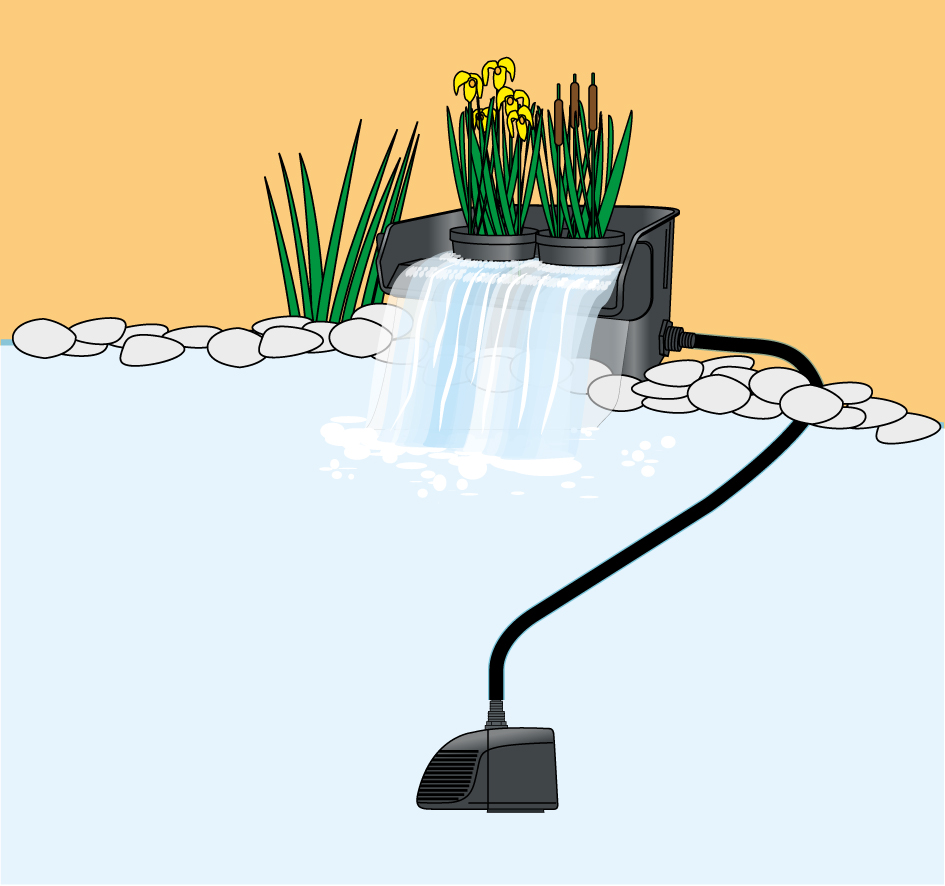
You can install the Waterfall Plant Filter next to the pond, either recessed into the ground, freestanding or raised. For a raised installation, ensure the base is strong enough to support the filter and will remain stable over time. The Waterfall Plant Filter must be level to prevent water from spilling over the sides.
Installation
Choose the desired location around the pond
You can install the Waterfall Plant Filter next to the pond, either recessed into the ground, freestanding or raised. For a raised installation, ensure the base is strong enough to support the filter and will remain stable over time. The Waterfall Plant Filter must be level to prevent water from spilling over the sides.
You can also make a multi layer waterfall with a maximum of 3 Waterfall Plant Filters below each other.

Notice! Always consider access to the waterfall reservoir for cleaning and maintenance when planning to cover or hide the unit in your final installation plan.
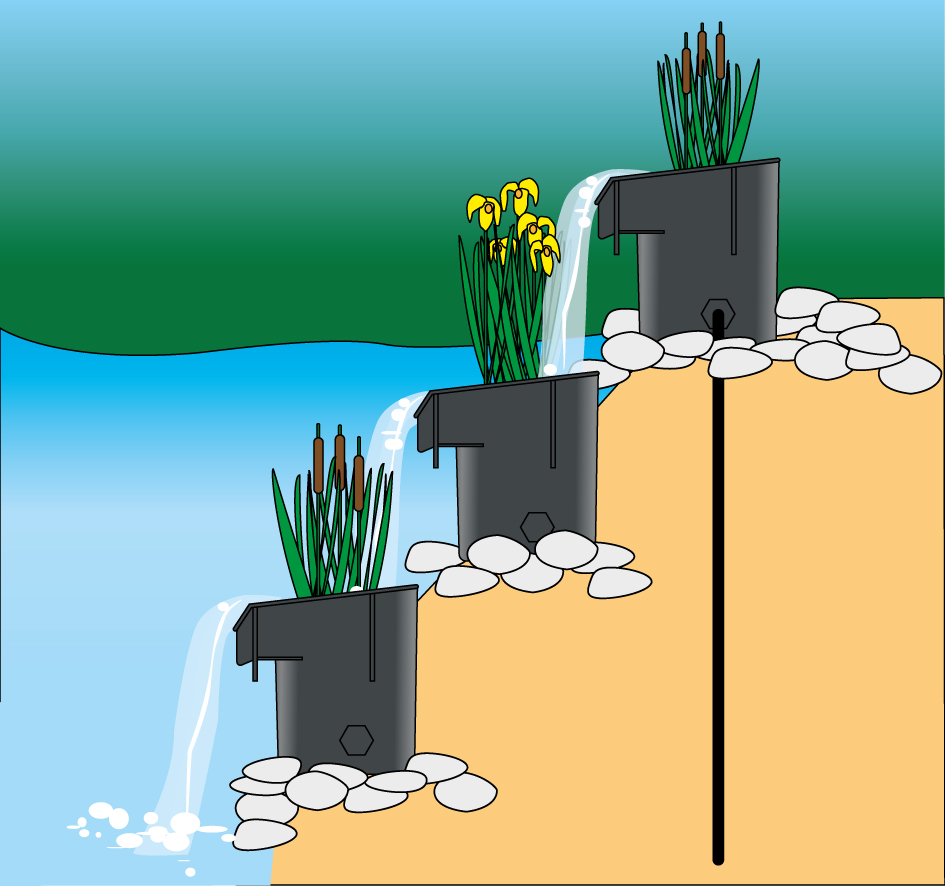
You can also make a multi layer waterfall with a maximum of 3 Waterfall Plant Filters below each other.
Notice! Always consider access to the waterfall reservoir for cleaning and maintenance when planning to cover or hide the unit in your final installation plan.
Pond Liner connection (pond liner not included)
Use a PVC pond liner to direct the water from the Waterfall Plant Filter into the pond, unless the filter is positioned at the edge of the pond so that the water can flow directly into it.
- Determine the size and shape of the liner needed to create a secure spillway and minimise water loss from splashing.
- Cut the liner as shown to ensure it fits the Waterfall Plant Filter container properly.
- Attach the top edge of the liner to the Waterfall Plant Filter using the bracket (h) and secure it with the 12 screws (i).
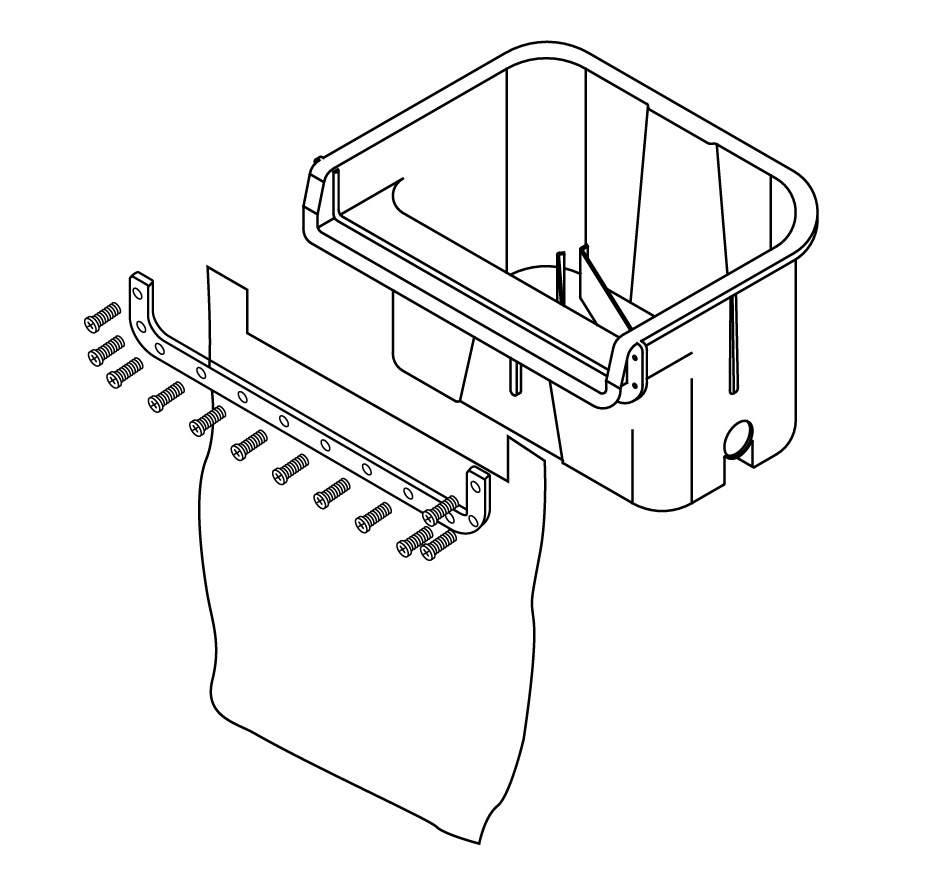
Pond Liner connection (pond liner not included)
Use a PVC pond liner to direct the water from the Waterfall Plant Filter into the pond, unless the filter is positioned at the edge of the pond so that the water can flow directly into it.
- Determine the size and shape of the liner needed to create a secure spillway and minimise water loss from splashing.
- Cut the liner as shown to ensure it fits the Waterfall Plant Filter container properly.
- Attach the top edge of the liner to the Waterfall Plant Filter using the bracket (h) and secure it with the 12 screws (i).
Choose the right pump (pump not included)
The pump required depends on the height of the Waterfall Plant Filter above the pond’s water level. The greater the height difference, the more powerful the pump needs to be. Position the pump in the deepest part of the pond, as far away from the waterfall outlet as possible.
We recommend SuperFish PondECO pumps, which provide efficient water circulation with low energy consumption.
| Height above pond level | Minimal pump capacity | Maximum pump capacity | Recommended pump |
|---|---|---|---|
| 0-50 cm | 2,000 l/h | 4,000 l/h | PondECO 4900 or PondECO Next 5000 |
| 50-100 cm | 3,000 l/h | 6,000 l/h | PondECO 8500 or PondECO Next 8000 |
| 100-150 cm | 5,000 l/h | 10,000 l/h | PondECO 12500 or PondECO Next 12000 |
Hose connection (hose not included)
Connect a pond hose with a diameter of either 25 or 40 mm to the Waterfall Plant Filter.
- The container (a) has inlet connections on the left, right and rear. Choose which connection to use for the water inlet and fit the sealing caps (b) to the two unused connections.
- If using a 40 mm pond hose, cut off the 25 mm section of the hose connector (b) before screwing it onto the container.
- Attach the hose securely to the hose tail and tighten it with the supplied hose clamp (c).
- Connect the other end securely to the pump. Place the pump in the pond and conceal the pond hose.
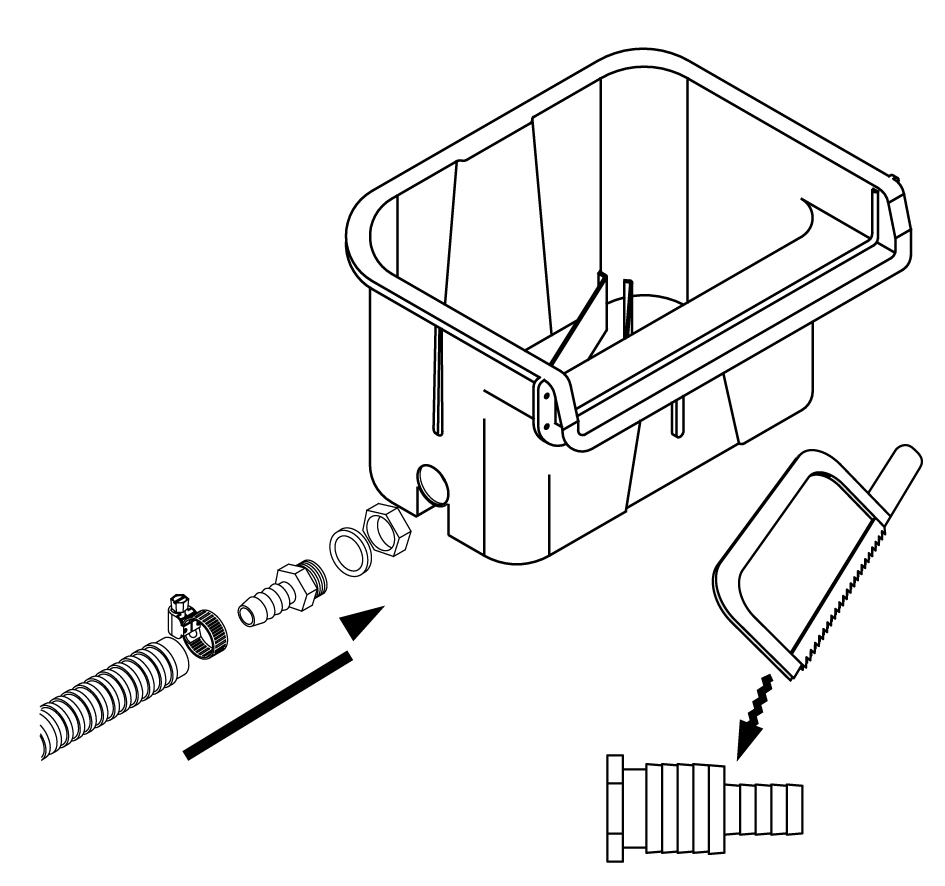
Hose connection (hose not included)
Connect a pond hose with a diameter of either 25 or 40 mm to the Waterfall Plant Filter.
- The container (a) has inlet connections on the left, right and rear. Choose which connection to use for the water inlet and fit the sealing caps (b) to the two unused connections.
- If using a 40 mm pond hose, cut off the 25 mm section of the hose connector (b) before screwing it onto the container.
- Attach the hose securely to the hose tail and tighten it with the supplied hose clamp (c).
- Connect the other end securely to the pump. Place the pump in the pond and conceal the pond hose.
Filter media
- Place the Bio-Balls (d) in the filter container.
- Add the blue (coarse) filter foam (e) on top, followed by the black (fine) filter foam (e).
- Finally, place the rack (g) on top and secure it by snapping it into place over the container rim.
Plant filter
Place helophyte plants (e.g. dwarf licorice, yellow iris, featherweed or reed) in the two plant pots, then set the pots in the rack above the filter mats. The water flows past the roots of these plants; this creates high concentrations of aerobic bacteria which convert the waste products in the water into nutrients for themselves and the plants.
Maintenance
Clean the filter whenever you notice a drop in performance. Cleaning frequency will depend on the conditions in your pond.
- Clean the filter foams weekly by rinsing them outside the pond with clean water. Replace them at least once a year.
- The Bio-Balls do not need to be replaced. Rinse them with pond water once a year.
- Clean the pump regularly, following the instructions in the pump manual.
- We recommend Colombo Bacteria products to support filter performance. Beneficial bacteria help break down waste and maintain a balanced pond environment.
- Never use cleaning agents or chemicals to clean the filter, as these can harm the pond environment.
- Before storing the filter for winter, ensure all filter media are clean and dry. Add beneficial bacteria when restarting the filter in spring.