


Marine Silicate Test (SiO2)
User manual
Understanding and controlling silicate levels
Silicate or Silica (chemically abbreviated as SiO2) is a nutrient used by diatoms (brown algae), which often appear as a brown, dusty coating on sand, rocks, and aquarium glass. Diatoms are common in newly established marine aquariums and often disappear naturally as the available silicate is consumed. Small amounts of silicate are generally harmless and may benefit organisms such as sponges.
Elevated levels of silicate, however, can encourage unwanted diatom growth. By using Colombo Silicate Ex to remove the silicate, the algae can no longer grow and will disappear.
General Guidelines
- Always take care that the test tube is clean before use.
- Clean the tube directly after use.
- Take the volume of the water sample as precisely as possible.
- Keep the drop bottle perfectly vertical during dropping.
- Take care that no air bubbles are included in the drops.
Test procedure:
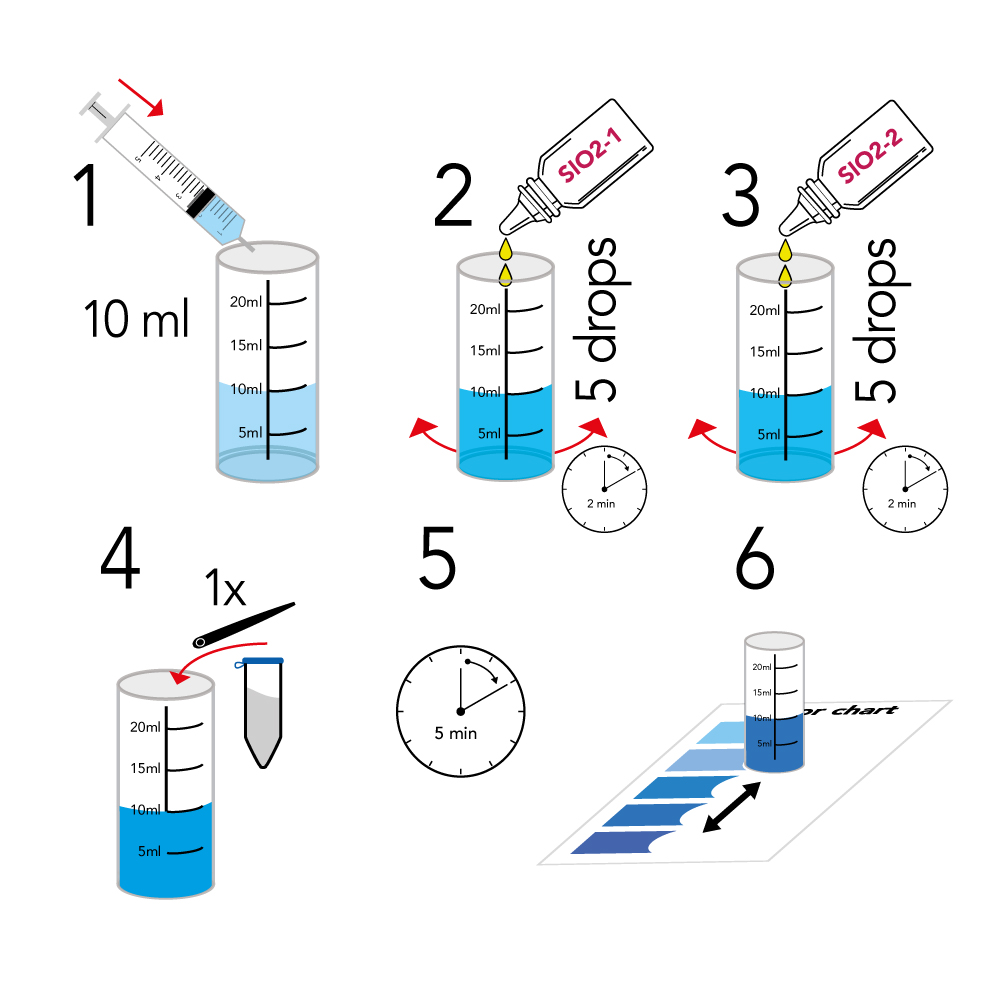
- Take a water sample of 10 ml.
- Add 5 drops of SiO2-1 test fluid, shake and wait 2 min.
- Add 5 drops of SiO2-2 test fluid, shake again and wait 2 min.
- Add 1 spoon of silicate powder and shake.
- Wait 5 minutes.
- Determine the SiO2-value using the included colour chart.
Test procedure:
- Take a water sample of 10 ml.
- Add 5 drops of SiO2-1 test fluid, shake and wait 2 min.
- Add 5 drops of SiO2-2 test fluid, shake again and wait 2 min.
- Add 1 spoon of silicate powder and shake.
- Wait 5 minutes.
- Determine the SiO2-value using the included colour chart.
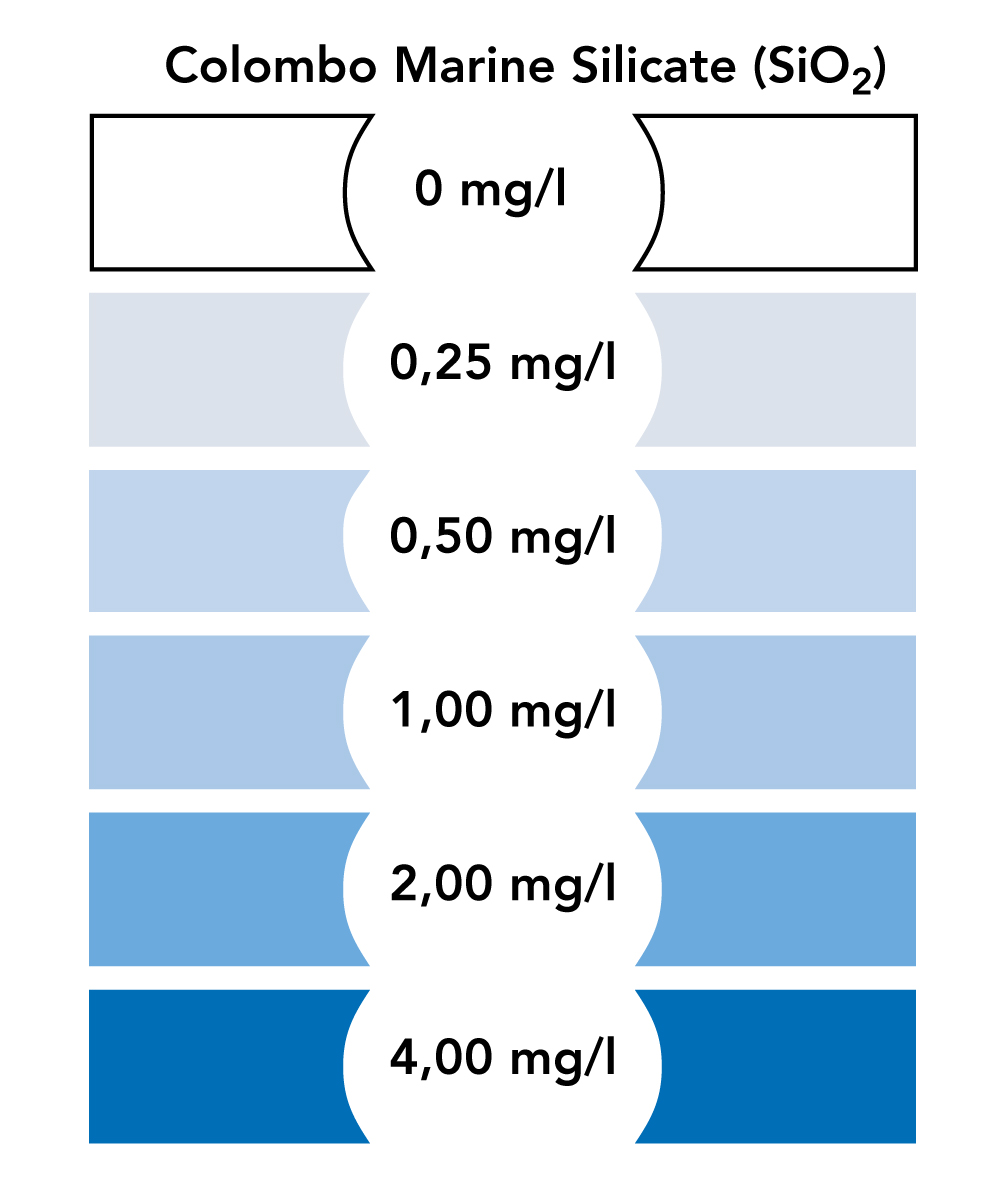
For judging the colour of the water sample after adding all the test fluids, proceed as follows: put the test tube on the included colour chart and look through the tube on to the chart from directly above it. Do not look in direct sun light, but at indirect light. Compare the colour of the water sample with the colours on the chart. The closest colour shows the corresponding value. Generally the colours of the sample and on the chart will not be exactly the same, as values in practice will always be between the standard values, and thus a mixture of both consecutive values. Therefore, one should estimate between which colours the sample really lies.
For judging the colour of the water sample after adding all the test fluids, proceed as follows: put the test tube on the included colour chart and look through the tube on to the chart from directly above it. Do not look in direct sun light, but at indirect light. Compare the colour of the water sample with the colours on the chart. The closest colour shows the corresponding value. Generally the colours of the sample and on the chart will not be exactly the same, as values in practice will always be between the standard values, and thus a mixture of both consecutive values. Therefore, one should estimate between which colours the sample really lies.